

Understanding DLC Certification: What It Means and Why It Matters

If you have shopped for LED horticultural lighting or looked into rebates and incentives, you have likely come across the term "DLC listed." The DesignLights Consortium (DLC) is a third party verification organization, often described as the ENERGY STAR of the lighting industry. A DLC listing tells you that a fixture has been independently tested and verified to meet a set of minimum performance requirements. For many rebate and incentive programs, DLC listing is a mandatory requirement, not just a nice to have.
At Sustainable Terrains, we work with DLC certification regularly, both for our own fixtures and in guiding customers through fixture selection. This piece walks through what the certification process actually involves, what the listing data tells you, and how the standards have evolved to close loopholes that once undermined the system.

How a Fixture Gets Listed
The path to DLC horticultural listing starts before a fixture ever reaches the DLC. A product first needs ETL or UL listing, the standard electrical safety certification. Only after that can it enter the DLC certification process.
From there, the fixture goes through a DLC approved testing lab, which runs a full range of tests covering output, power factor, and a broad set of electrical and photometric measurements.
[Note: the fuller list of specific parameters tested, drawn from the lab's report, can be added here once finalized. We are not naming the lab contact, but we can reference the testing lab itself, LightLab International, if that is the direction you want.]
What the Listing Data Actually Shows
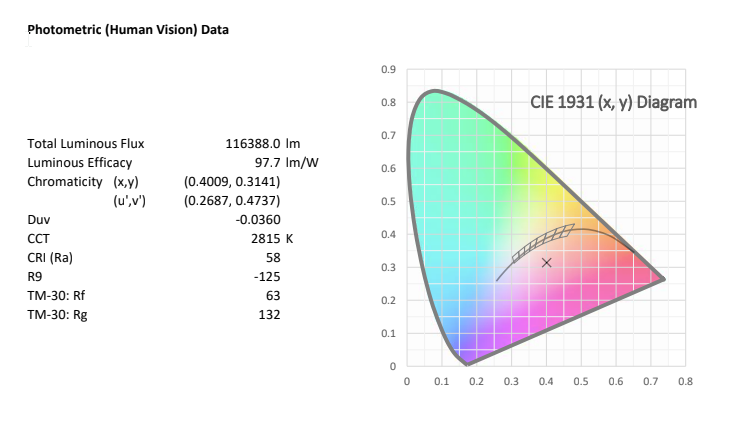
Each fixture on the DLC's Qualified Products List (QPL) includes manufacturer, brand, and model information alongside detailed technical data, including:
Efficacy. The current minimum threshold is 2.5 micromoles per joule, with a 5 percent tolerance, meaning a fixture testing at 2.38 micromoles per joule or higher still qualifies. This is a significant increase from the earliest horticultural requirement of 2.0 micromoles per joule, which was set to be comparable to or better than HPS.
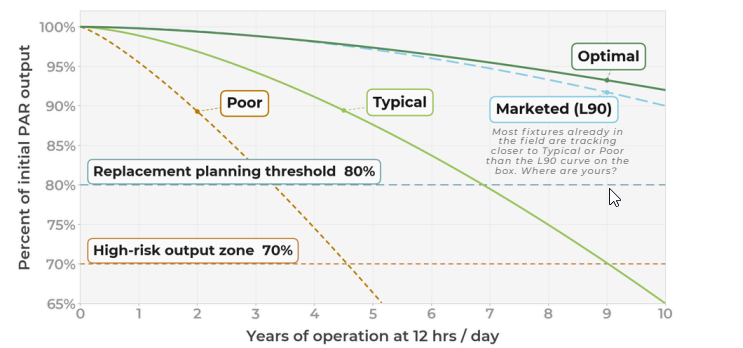
Ambient temperature rating. Most fixtures are rated to 40°C, though newer fixtures are increasingly rated to 45°C. This rating has a direct impact on expected fixture lifetime.
Control features. Listings specify whether a fixture is tunable or dimmable and detail the dimming protocol, for example 0 to 10V control, dim-to-off capability, and connection type.
Spectral output. Total flux is broken down by wavelength range, including blue, green, red, and far red.

Electrical specifications. Wattage, input voltage range, and total harmonic distortion, all of which become increasingly important at scale, when many fixtures are installed together.
Spectral curves, available for download on each listing.
The DLC updates its horticultural requirements periodically, typically every couple of years, generally raising minimum efficiency thresholds and updating sampling and testing protocols.
Closing the Loopholes
Earlier versions of the DLC certification process relied more heavily on manufacturer-reported data, which created room for manipulation. Some manufacturers would submit a single, unusually high-performing unit for testing, sometimes referred to in the industry as a "unicorn" or "golden sample," that did not represent what actually shipped to customers. In some cases, manufacturers would even list a model variant that was never actually sold, simply to post a stronger number on paper.
The DLC has since closed much of this gap by requiring testing through DLC-approved labs and introducing random sample testing requirements. As a result, reported and tested metrics now align far more closely than they once did, and this type of manipulation has become far less common.
State Level Compliance Considerations
Beyond the DLC's own listing requirements, some states apply additional rules for specific applications. Specialty crop cultivation facilities have state-level efficiency and wattage requirements in states such as Massachusetts and Illinois, which maintain closely related wattage-per-square-foot standards. The DLC's site includes filtering tools to help identify fixtures that meet a given state's requirements.
Using the Listing Data for Comparison
Fixture listings can be saved as a PDF for recordkeeping, or added to a list within the DLC platform and exported for side-by-side comparison. This is useful for specification work, though the volume of available data typically requires some filtering to focus on what matters for a given project.
It is also worth noting that many different brands in the market are manufactured by the same underlying producer. Revie
wing listing data closely can reveal these relationships.
Staying Listed
A DLC listing is not permanent. Manufacturers are required to maintain their listing and relist when the DLC updates its version requirements, or the listing lapses. The DLC also maintains a searchable record of unlisted fixtures, those that have lapsed or been removed from the current list, along with an API providing access to both historical and current listing data.
[Note: per internal notes, there is a plan to integrate this API into our own testing services and website. Confirm current status before referencing this publicly.]
Why This Matters
DLC certification plays an important role in consumer protection and in raising the bar for efficiency across the lighting industry. Understanding how the process works, and how the standards have tightened over time, is useful for anyone evaluating fixtures for a rebate program or a cultivation facility build-out.


Comments