

The RF700: Built Like Infrastructure, Not a Consumable

Updated: Aug 5

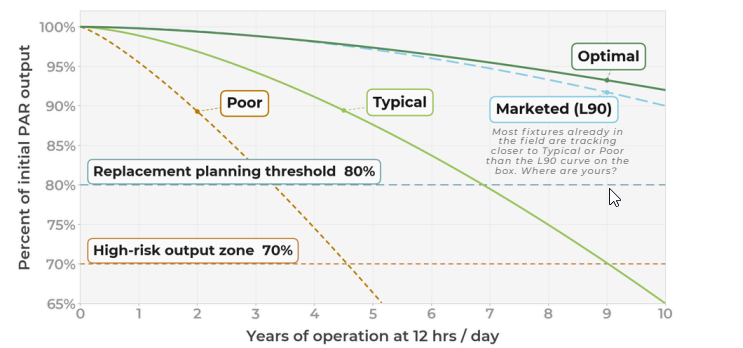
Most conversations about grow lights start and end with output numbers. That's a mistake. A fixture that puts up a great spec sheet number on day one and can't survive three years in a working cultivation environment isn't infrastructure. It's a recurring expense with a delay built in.
The Valoya RF700 was engineered around a different question: what does a fixture need to hold up, physically and spectrally, over years of real operating conditions, not just a lab test at time zero.
Component Protection That Actually Holds Up
Most LED horticultural fixtures rely on a polycarbonate lens or a conformal coating to protect the diodes underneath. Both degrade over time. Coatings can yellow, and that yellowing changes the spectrum reaching your canopy without you knowing it's happening.
The RF700 uses a tempered glass lens instead. That single design choice does three things at once:
It protects the diodes without altering the spectrum. Glass doesn't yellow or degrade the way a coating can, so the light quality coming off the fixture stays consistent over its service life.
It makes the fixture genuinely cleanable. Salt buildup from hard water, scale, foliar residue, all of it wipes off, and you can visually check for film or buildup rather than guessing. That means real maintenance between growth cycles, not a fixture you have to replace because you can't clean it safely.
It's built to survive impact, not just wipe-downs. The lens is shatterproof and passes a drop test.

Component Quality, Not Just a Spec Sheet Number
Inside the housing, the RF700 uses Samsung LM301B chips for its white diode base, combined with dedicated Osram diodes for red output, a dedicated 385nm UV-A source, and a dedicated far-red channel, rather than relying on the spectral tail of a single white chip to cover multiple jobs. Each channel is sourced and driven independently, which matters more over time than it does on day one.
The power supply is built around U Power Tech drivers, which have consistently outperformed common commercial alternatives for horticultural applications on inrush current handling and overall power management.
Engineered for the Room, Not Just the Bench
A few details that matter once a fixture is actually installed at scale:
A white enamel chassis coating maximizes reflected light rather than absorbing it, reducing wasted output across a room.
An asymmetrical chassis design puts material only where structural support is needed, function over form, without sacrificing durability.
Heavy gauge cabling with LLT connectors supports daisy-chain installation with up to 5 feet of spacing between fixtures, simplifying electrical runs across a room.
That daisy-chain design isn't just a convenience on paper. Nick Cibelli, a grower in Maine running the RF700, put it this way during a power outage:
"The daisy-chained power cords were a game changer during a power outage. I ran a whole row off one generator plug."

Built to Take a Beating
Cultivation environments are hard on equipment: humidity, temperature swings, chemical exposure from cleaning and foliar applications. The RF700 is rated to operate safely in ambient temperatures up to 40°C (104°F), well above the 35°C ceiling common on many standard fixtures. In the field, that engineering has translated into a documented failure rate under 1% across three years of commercial use.
A Full Range, Not a Single SKU
The RF700 line isn't limited to one wattage or one footprint. Current options include 300W, 400W, 600W, and 720W versions in a 4x4 form factor, with a 960 to 1000W version in development. A 2x4 footprint version is also available, useful for filling a 10-foot bench run or completing a 2x4 rack layout. That range makes it easier to hit a specific wattage-per-square-foot target where local requirements call for one.
Certified for Today's Rebate Landscape
As of May 6, 2026, the RF700-6 Solray385 is DLC Listed under the newest Version 4.0 Technical Requirements, the most rigorous standard the DLC has released to date. That listing supports eligibility for utility rebate and incentive programs across North America, which can meaningfully offset the upfront cost of an installation.
The Bottom Line
Lighting that's built to be serviced, cleaned, and trusted for years, rather than replaced on a shorter cycle, is the difference between a commodity purchase and an infrastructure investment. The RF700 was built around that distinction from the housing out.


Comments