

PPFD on Canopy: Why the Inverse Square Law Isn't the Whole Story

This one tends to get pushback the moment it comes up. Raise it with a plant physiologist and you may get a flat denial that you're questioning the laws of physics. Worth addressing head on, because the pushback is fair and the point still stands.
The inverse square law is real. It is not up for debate. Move a light meter away from a single point source and intensity drops exponentially, every time, no exceptions. A candle in a dark room behaves exactly the way the math says it will.
The question worth asking is what happens once you stop dealing with a single point source.

One Fixture Is Not the Same Problem as a Hundred
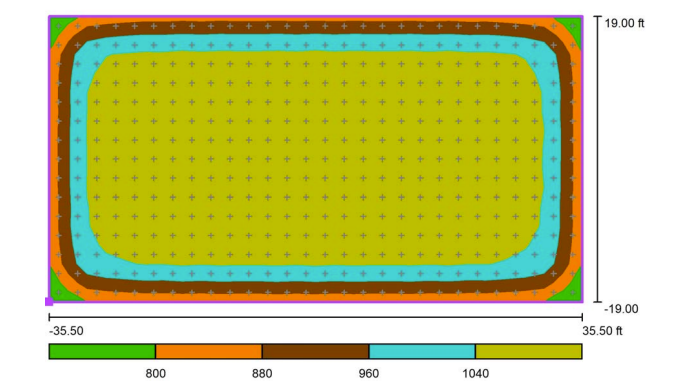
Walk into a room lit by a single fixture with no reflection and the inverse square law holds up cleanly, within a reasonable margin. That is not the situation in most commercial growing environments. A single room might have a hundred fixtures mounted across the ceiling. At that point you are not measuring a point source anymore. You are measuring an array, and an array behaves differently than a candle in a dark room.
That distinction explains a pattern that used to be confusing: rooms running legacy fixtures mounted several feet above the canopy, reading a modest PPFD number at the top of the plant, and still producing results that didn't match what that number was supposed to predict. The math wasn't wrong. The model was incomplete. It was built around a point source assumption applied to a system that was actually an array.
PPFD Is Flat. Growing Isn't.
PPFD, photosynthetic photon flux density, is a surface measurement. It is two-dimensional by definition. That works fine for a crop that grows as a single flat plane, something like lettuce sitting in a tray. It works much less well for a tall, dense, multi-layer canopy, where the goal is usable output from top to bottom, not just at the very top of the plant. The same challenge shows up in indoor corn production for crop science applications. Any crop with real vertical depth to its canopy runs into the same gap between how PPFD is measured and how light actually needs to reach the plant.
Observations from growers' own field explorations have repeatedly outpaced the theory built to explain them. Growers have pushed past assumed limits, produced results that didn't fit the existing model, and forced the model to be reverse engineered and reapplied after the fact. That pattern, results outrunning the framework meant to predict them, has driven real leaps in horticultural lighting technology, leaps not seen in decades, largely thanks to the shift to LED based systems that made this kind of experimentation and fine tuning possible in the first place.

Down With Canopy Penetration
"Canopy penetration" is a phrase worth retiring. You cannot force light through a leaf. Light either reaches a lower leaf by traveling around and between the leaves above it, or it doesn't reach it at all. The goal is diffusion, not penetration, and that changes how a fixture should actually be built and mounted.
The clearest way to see this in action has nothing to do with a grow room. Take a PAR meter into a cornfield. Read it twenty feet up, ten feet up, and at ground level, and you'll get roughly the same number each time. Sunlight is diffuse by the time it reaches a plant, largely because of the atmosphere it passes through, and that diffusion is exactly what makes it effective at every level of a tall canopy at once.
Early LED horticultural fixtures got this backwards in one common failure mode: tight 30 degree optics posting an impressive 2,000 PPFD in a narrow, focused spot. Numbers like that look great on paper. They don't hold up agronomically. Three hundred watts of tightly focused light does not do the job of a thousand watts spread out properly.

Finding the Right Throw
At a systems level, the better questions are about wattage density and total photon delivery once efficacy is factored in, not the peak PPFD reading directly under one fixture. Over-focusing light wastes the benefit of diffusion. Over-diffusing wastes light to the walls, a 180 degree throw loses a meaningful share of output that way, though that tradeoff makes sense in a few specific applications. The practical sweet spot for most rooms sits closer to 110 to 130 degrees of throw, mounted at a sensible height to let that light diffuse properly down through the canopy.
Growers in the Netherlands have effectively run this playbook for decades in greenhouses, mounting fixtures well above the crop and relying on wattage density and diffusion rather than proximity. It works at the scale of a single bench and it works across a twenty acre greenhouse, for the same underlying reason.
The Actual Takeaway
Lighting for a real canopy is a three-dimensional problem, not a two-dimensional one, and the geometry of whatever is being grown matters as much as the fixture spec sheet. PPFD at the top of the canopy is a useful data point. It was never meant to be the whole picture.


Comments