

Shift Happens: HPS

High-pressure sodium lighting, especially the double-ended thousand-watt HPS, has been the workhorse of the horticulture industry for a decade, and it remains relevant for many growers today. Some stick with it because the system already works. Others simply have not had a reason to change. Either way, running legacy HPS is one decision. Making sure it is properly optimized is another.
A lamp replacement schedule is one of the easiest maintenance items to let slip. Without a clear SOP, or through normal staff turnover, lamps can end up running for years longer than intended, quietly costing yield the entire time.
The Problem With Trusting a PAR Meter Alone
A PAR meter is a useful tool, but it does not tell the whole story. A grower checking an aging room with a PAR meter might see only an 8 to 10 percent reduction in output, if they even have a baseline reading from when the lamps were new. That modest-looking number can be misleading.
The reason a small PAR reading can hide a much larger yield problem comes down to spectral shift, not just intensity loss.
What Is Actually Happening as an HPS Lamp Ages
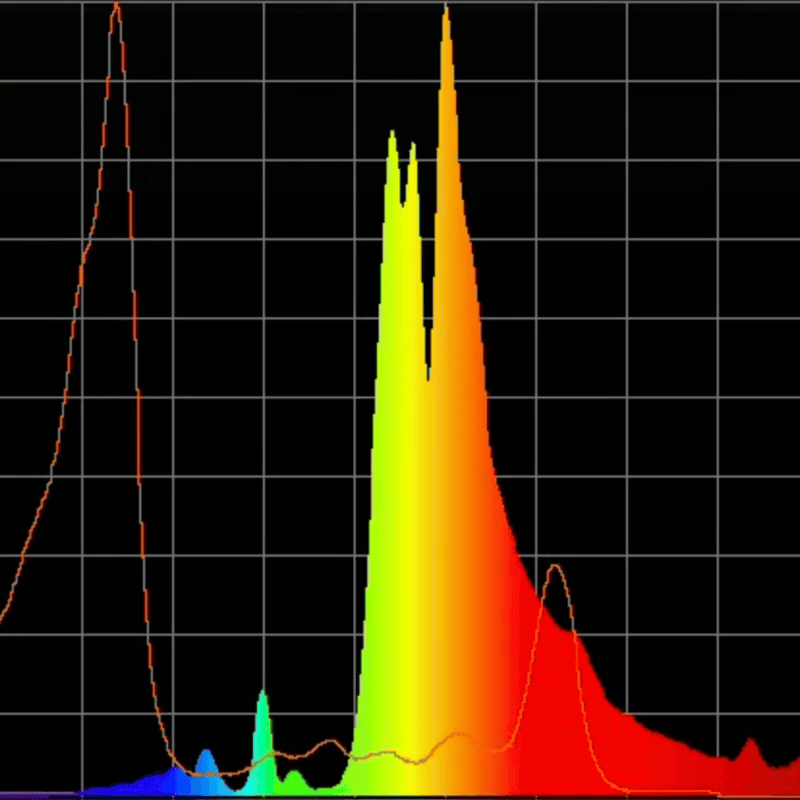
As an HPS lamp ages, the plasma reaction inside it begins to break down. Contamination and oxidation set in, and the spectral output shifts to the right, meaning energy moves out of the blue range and increasingly into red, far red, and eventually infrared. A PAR meter measuring the standard 400 to 700 nanometer range, or 350 to 800 nanometers on some meters, still reads a substantial amount of energy in range. What it does not capture well is how much of that energy has migrated toward the far red end of the spectrum, and how much more is simply being lost as heat.
This matters because the ratio of red to far red, and far red to red, has a direct effect on plant morphology, including leaf expansion, metabolism, and overall quality. A new bulb, right out of the box, delivers those ratios in balance. That balance holds reasonably well for a while, but it begins to slide meaningfully after roughly the 24 to 30 month mark.
Plant Responses
Once far red output climbs too high relative to red, plants respond with longer internodal spacing and wider leaf expansion, a shade avoidance response. The Emerson effect, the well-documented effect between red and far red light, is a real benefit at the right ratio. Past a certain point, however, that same interaction becomes oversaturated, and what was a benefit starts working against plant morphology and yield.
Replacement Interval SOPs
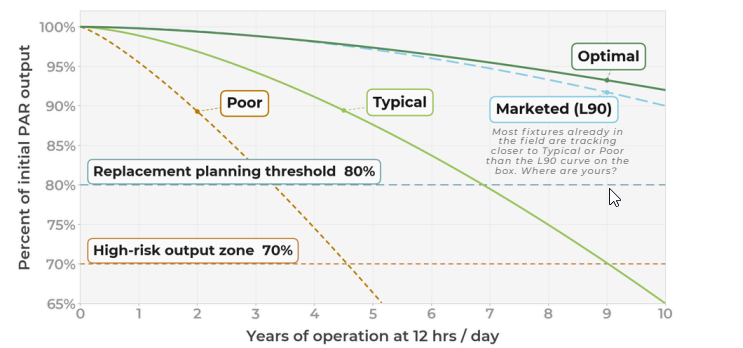
In a well-run facility, the best practice is to replace HPS bulbs every 24 to 30 months. That window balances lamp cost against the yield loss that comes with spectral degradation.
Bulb Quality Matters as Much as Timing
Double-ended thousand-watt HPS bulbs range from roughly $20 to $70 at the consumer level, and the difference is not just price. Lower-cost bulbs carry real risks, including ballast incompatibility, fire hazard, and less stable spectral output over their lifespan. Ushio has long been considered the gold standard in this space, with a small number of other manufacturers competing at a similar quality tier, some at a higher price point and some more moderately priced.
Running lower-cost bulbs is a legitimate choice, but it comes with a tradeoff. It requires a tighter SOP, more frequent monitoring, and more labor to manage the added variability, and those costs accumulate over time. If HPS is going to be part of a facility's lighting strategy, sourcing the best available bulbs is generally the more economical path over the life of the investment.
Why the Math Matters
Consider a single HPS lamp producing 2.5 pounds of flower per cycle at a wholesale price of $1,500 per pound, or $3,750 in revenue per lamp per cycle. A 10 percent yield loss reduces that to 2.3 pounds, a loss of roughly $375 per lamp per cycle. Across a 100 lamp room, that is a $37,500 reduction in harvest value in a single cycle, against a replacement cost for those 100 lamps of approximately $6,000. Even at the more conservative end of the yield loss range, the case for staying on schedule is straightforward.
The Bottom Line
HPS has earned a renewed appreciation in recent years, particularly for its heat contribution to canopy and the predictability of its output, as long as end-of-life bulbs are sourced and handled properly. The tradeoff is that it is a technology that degrades in a way growers need to actively manage. Knowing the age of your lamps, and replacing them on a defined schedule rather than waiting for a visible problem, is one of the more straightforward ways to protect yield and margin at the same time.


Comments